
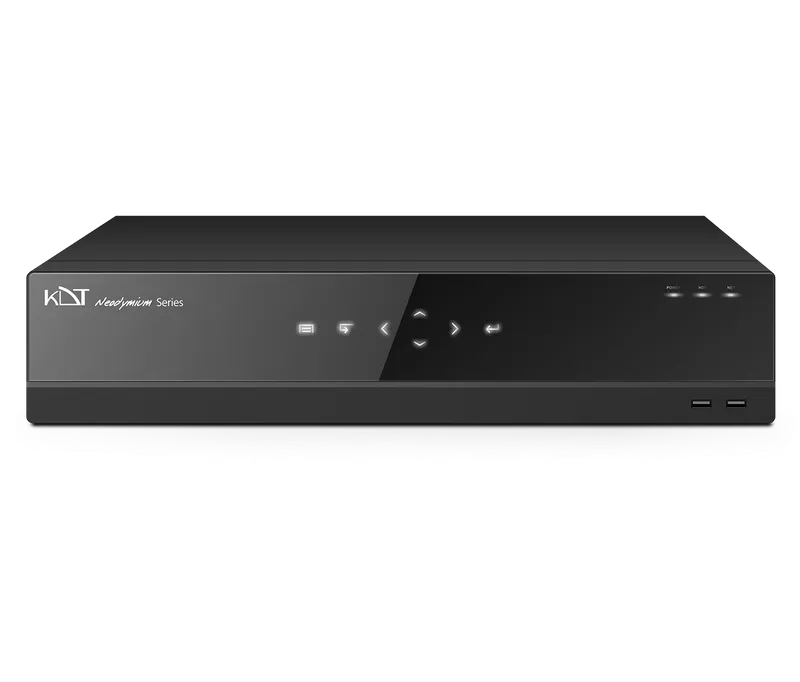
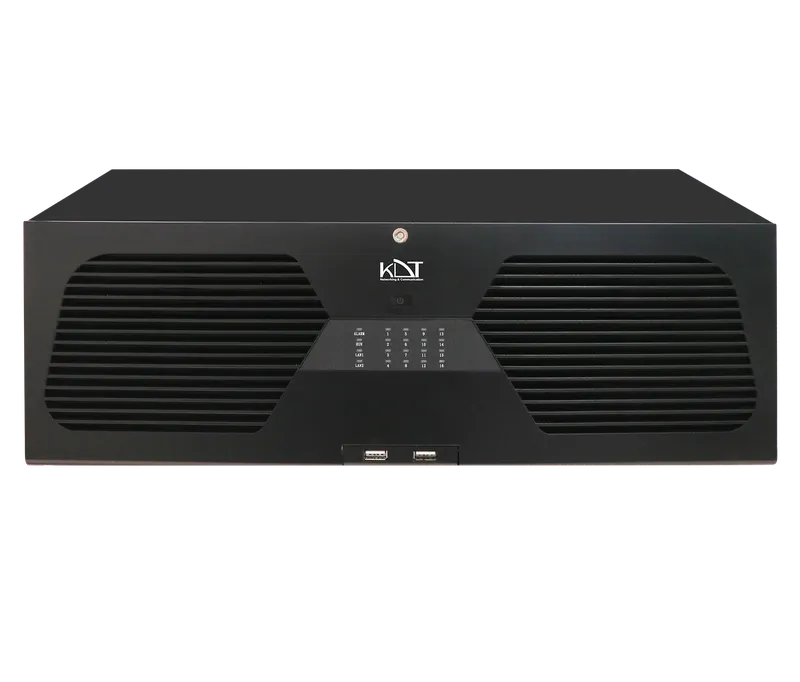
The KN-3282NHR network video recorder from the Neodymium series is a professional solution for centralized video management in large surveillance projects.
-
 NO.of Channels
32CH
-
 NO.of HDDS
8HDD
-
 Smart Code
CODEC
Overview
The KN-3282NHR network video recorder from the Neodymium series is a professional solution for centralized video management in large surveillance projects. With support for 32 IP cameras and eight internal hard disks, it offers extensive storage capacity in a standard rack-mountable chassis. Its powerful processor, paired with a dedicated graphics processor, delivers smooth ultra-high-resolution video on multiple displays simultaneously, and a complete suite of intelligent video analytics is built in, from face detection to people counting. A bilingual Persian and English user interface, together with dedicated mobile and Windows apps, makes managing and monitoring the system simple and enjoyable for Iranian users.
CPU & GPU Capabilities
- CPU
- Quad-Core ARM Cortex
- GPU
- ARM Mali-G610MC4
- IP Channel Input
- 32CH x 8K@30fps (Up to 32MP Supported)
Recording
- Video Resolution
- 1080P, 12MP, 16MP, 2CIF, 32MP, 3MP, 4CIF, 4MP, 5MP, 720P, 8MP, CIF, DCIF, QCIF, VGA
- Input Bandwidth
- 1024Mbps or 512 Mbps (when RAID is enabled)
- Record Mode
- Alarm, Event, Manual, Schedule, Smart Event
- Failover
-
N+
1 Hot Spare - Pre & Post Record
- Post 10~300 sec, Pre 1~30 sec
Network & Monitoring
- Protocols
-
HTTPs, HTTP, TCP/
IP V4-V6, ICMP, RTSP, UDP, NTP, DHCP, DDNS, FTP, SNMP-V1-V2-V3, UPNP, P2P, NAT, Multi Cast - Compatibility
- Onvif Ver2.6, Profile S, G, T, CGI, SDK, API
- Output Bandwidth
- 800Mbps or 400 Mbps (when RAID is enabled)
- User
- 32 Users
- Streaming Method
- Multicast, Unicast
- Windows Software
-
Unlimited KDT CMS/
VMS - Smart Device
- IOS Android Phone & Tablet
Interfaces
- Network
-
2xRJ45/ 1x2.5GE Or 2 x self-adaptive Ethernet interface, (10/
100/ 1000Mbps)+ LED Indicator
Smart Function
- Intelligent Functions
- 20 Smart Function Line Crossing Area Intrusion Face Detection Audio Exception Detection Unattended Objects Object Missing Region Entrance Region Exiting Fast Moving Loitering Detection People Gathering Detection Parking Detection Blurred Detection Scene Change Detection People Counting Video Shelter Motion Detection Human Detection Car Shape Detection
Video/Audio
- Video Output Mode
- 4CH HDMI video output 2CH VGA Simultaneous mode max. resolution of HDMI1 is 8K max. resolution of HDMI2 HDMI4 is 4K max. resolution of VGA1 VGA2 HDMI3 is 1080P Heterologous mode Simultaneous video source output for VGA1 and HDMI4, Simultaneous video source output for VGA2 and HDMI2 max. resolution of HDMI1 HDMI4 and HDMI2 is 4K max. resolution of HDMI3 is 1080P max. resolution of VGA1 and VGA2 is 1080P
- HDMI 1 Output
-
7680 × 4320/
30Hz, 3840 × 2160/ 30Hz, 1920 × 1080/ 60Hz - HDMI 2 Output
-
3840× 2160/
30Hz, 1920 × 1080/ 60Hz, 1280 × 1024/ 60Hz - HDMI 3 Output
-
1920 × 1080/
60Hz, 1280 × 1024/ 60Hz, 1280 × 720/ 60Hz - HDMI 4 Output
-
3840× 2160/
30Hz, 1920 × 1080/ 60Hz, 1280 × 1024/ 60Hz - VGA 1 Output
-
1920 × 1080/
60Hz, 1280 × 1024/ 60Hz, 1280 × 720/ 60Hz - VGA 2 Output
-
1920 × 1080/
60Hz, 1280 × 1024/ 60Hz, 1280 × 720/ 60Hz - Main/
Secondary Screen Split - 1.4.8.9.16.25.36.64 screen split
- Audio Output
- 2CH, RCA
- Video Compression
-
H.264+
(Ultra H.264) H.265+ (Ultra H.265) Smart Event Codec - Audio Compression
- G.711a, G.711u
Playback & Backup
- Decoding Capability
- H.264, 16CH 1080P@30fps, 8CH 4Mp@30fps, 4CH 8Mp@30fps, 2CH 16Mp@30fps, 1CH 32Mp@30fps H.265, 32CH 1080P@30fps, 16CH 4Mp@30fps, 8CH 8Mp@30fps, 4CH 16Mp@30fps, 2CH 32Mp@30fps
- Search Mode
- Alarm Input, All Smart Function, Motion, Time & Date
- Playback Mode
- Normal, Time Division, Label, Event, Picture Playback, Smart Playback, ANR Support
- Backup Mode
- Cloud Storage, Network, USB Device
General
- Web Viewer
- Chrome, Edge, Firefox, IE
- Power Supply
- 200~240V AC, 50~60Hz
- Power redundant
-
N/
A - Working Environment
- -20°C ~ + 50°C / 10% ~ 90% RH (Non condensing)
- Rackmount
- Yes 2 Unit
- Dimension (W×D×H)
- 440*452*90 mm
- Weight
- 7.3 Kg Without HDD
Hard Disk
- HDD
- 8 SATA
- Capacity
- Up To 22 TB For Each
- RAID Support
- 0-1-5-10
- Group HDD
- Yes
External Interface
- 4G Dongle / Wifi
- Supported
- USB Interface
- Front Panel: 2 × USB 2.0 Rear Panel: 2 × USB 3.0
- eSATA
- 1
- Alarm In / Alarm Out
- 16 / 8
- Controller
- 1 x RS-232, 1 x RS-485 Interface
- 12V Out
- 1
Guarantee
- Power Consumption
- ≤30 W Without Hard Disk
- Product Guarantee
- 3 Years Platinum Guarantee
- MTBF
- 100,000 hrs min. MIL-HDBK-217F (25°)
Downloads
Documentation
-
KN-3282NHR
Software and firmware
8 files, newest first. Pick the version that fits your device and download it.
20260820-V500.XXXX.R00X.5001.upf Latest
20260320-V500.XXXX.R00X.5001.upf
20251215-V500.XXXX.R00X.5001.upf
20251015-V500.XXXX.R00X.5001.upf
20250930-V500.XXXX.R00X.5001.upf
Older versions (3)
20250820-V500.XXXX.R00X.5001.upf
20250523-V500.XXXX.R00X.5001.upf
20250419-V500.XXXX.R00X.5001.upf
Update guides
آموزش آپدیت رکوردر از طریق نرم افزار .pdf
Compare products
Compare this product with similar products
Please wait
Frequently asked questions: Network Storage
Answers to common questions about this product line, from the KDT Help Center.
Can I use an ordinary desktop hard disk in an NVR, or does it have to be a surveillance-grade disk?
Use surveillance-grade disks, or at least NAS-class disks rated for 24/7 operation. Desktop disks are commonly specified for about 2,400 power-on hours per year (24/7 operation is 8,760 hours) and a workload of around 55 TB/year, while surveillance disks are designed for continuous operation and typically rated at 180 TB/year, with higher-end surveillance and AI models often rated at up to about 550 TB/year. Surveillance firmware is optimized for many simultaneous write streams, typically up to 64 HD cameras per disk, and keeps the stream flowing instead of retrying a weak sector for a long time, which helps prevent dropped frames; many larger models also have vibration sensors for multi-bay chassis. A desktop disk may work at first, but under 24/7 recording it usually develops gaps, errors and a shorter life.
What does a disk's workload rating in TB/year mean, and how do I know whether my system exceeds it?
The workload rating is the amount of data the manufacturer expects the disk to read plus write per year while still meeting its reliability specification; typical values are 55 TB/year for desktop disks and 180 TB/year for surveillance disks. One megabit per second of continuous traffic equals about 3.94 TB per year, so a 180 TB/year disk corresponds to roughly 45 Mbps of round-the-clock traffic, including playback and backup reads. Example: 16 cameras at 4 Mbps recorded on a single disk means 64 Mbps, or about 252 TB/year, which exceeds a 180 TB/year rating; spreading the recording over two disks (about 126 TB/year each) or choosing a higher-rated model solves this. Exceeding the rating does not stop the disk immediately, but it increases the probability of failure.
What is the difference between CMR and SMR disks, and does it matter for recording?
CMR (conventional magnetic recording) writes tracks side by side, while SMR (shingled magnetic recording) partly overlaps them to increase density; changing data on an SMR disk means rewriting neighbouring tracks, so sustained or scattered writes slow down sharply once its internal cache is full. In a single-disk recorder with mostly sequential writes the difference can be small, but in RAID arrays SMR disks can make rebuilds extremely slow and may even be dropped from the array. For multi-disk recorders and RAID, choose CMR disks and check the recording technology in the manufacturer's datasheet before buying.
Is a 7200 rpm disk better for recording than a 5400 rpm one?
For recording, rotational speed matters much less than firmware and workload rating. Even a 5400 rpm-class surveillance disk sustains well over 50 MB/s (400 Mbps) of sequential writing across the whole disk, far more than a typical NVR writes: 32 cameras at 4 Mbps are only 128 Mbps, or 16 MB/s. 7200 rpm disks help in large RAID arrays, in faster rebuilds and under heavy simultaneous playback and search, at the cost of more heat, power and noise. In a small NVR, a cooler 5400 rpm-class surveillance disk is a perfectly good choice.
Is it acceptable to use a used or refurbished hard disk in an NVR?
It is not recommended for recordings that may serve as evidence, because the remaining life of a used disk is unknown and 24/7 recording is a demanding workload. If you must use one, check its SMART data first: power-on hours (attribute 9) show its age, and any reallocated (attribute 5) or pending (attribute 197) sectors are a reason to reject it; then run a full (long) self-test before installation. Buy only from a trusted seller, since the SMART counters of resold disks are not always reliable.
Didn’t find your answer?
Warranty
3-Year Platinum Warranty
This product comes with the official KDT warranty. Check your device’s warranty status with its serial number.
Check warrantyRelated products
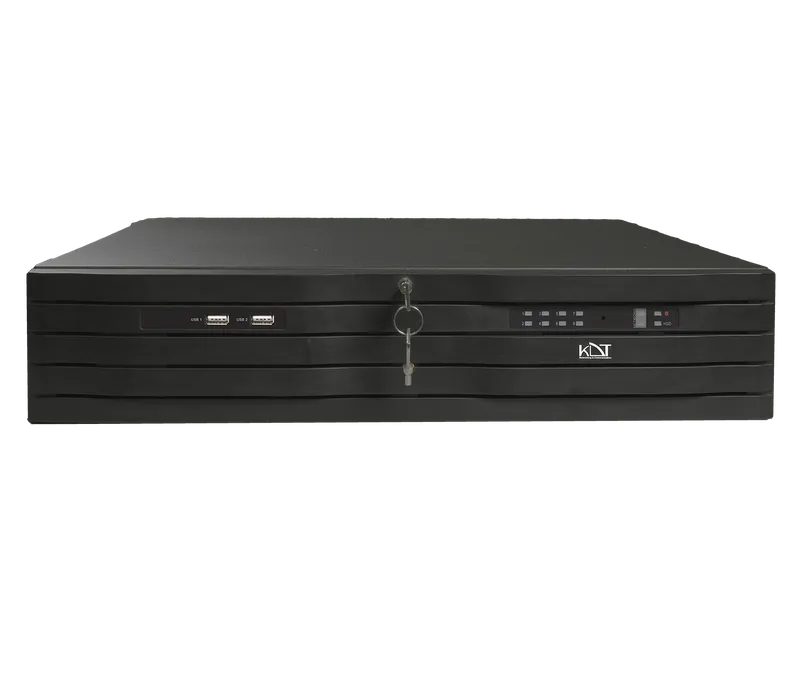 32 Channel 8 HDD Hot Swap 2U 8K NVRKN-3282NHRW
- 32 Channel 8 HDD Hot Swap 2U 8K NVRKN-3282NHRWS
- 64 Channel 8 HDD 2U 8K NVRKN-6482NHR
- 64 Channel 8 HDD Hot Swap 2U 8K NVRKN-6482NHRW
- 64 Channel 8 HDD Hot Swap 2U 8K NVRKN-6482NHRWS
 64 Channel 16 HDD Hot Swap 4U 8K NVRKN-64164NHRWS
- 128 Channel 16 HDD Hot Swap 4U 8K NVRKN-128164NHRWS